4407 Manchester Ave # 204, Encinitas, CA 92024, United States
Who We Help
Symptoms and conditions where the upper neck often plays a role.
Most symptoms are not isolated. They reflect how the body has adapted to stress over time: past injuries, posture, work demands, sleep, training load, and the small accumulations that come with daily life. The upper cervical complex is one of the places where those patterns most often converge, because of how much the region influences posture, balance, head position, and nervous system function.
This page covers the conditions we see most often. In each case, the question is the same: is the upper cervical complex contributing to what you are experiencing, and if so, how do we address it specifically? The answer comes from the exam, not from assumptions. When upper cervical care is part of a larger picture, we are happy to coordinate with the other providers in your life.
Neck pain
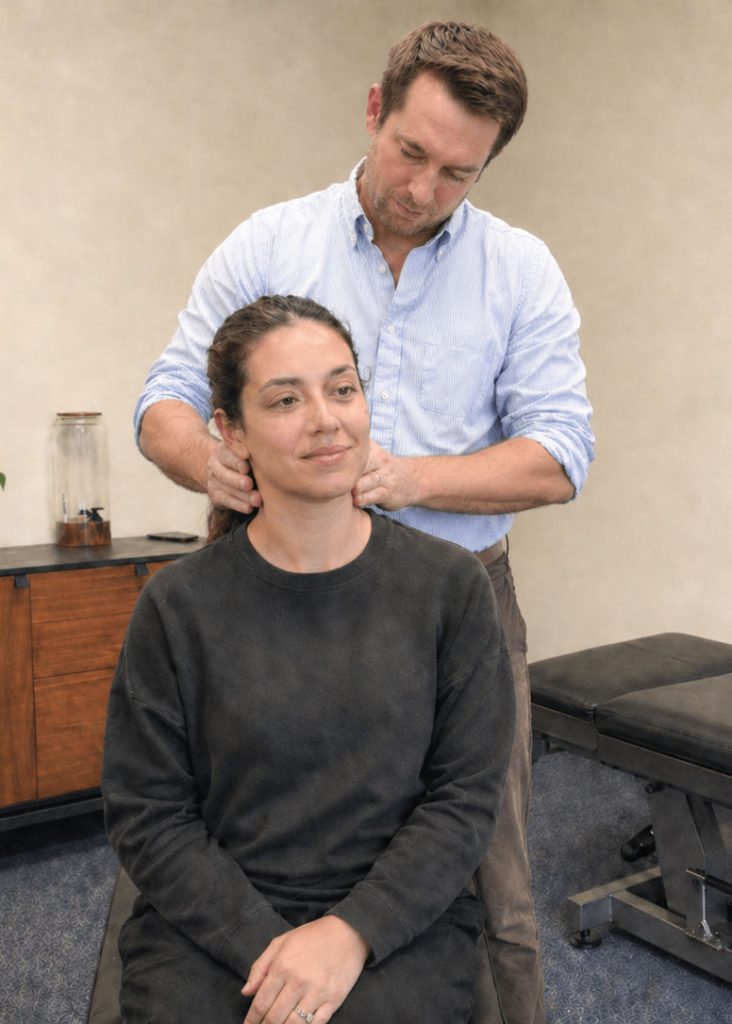
Neck pain is the most common reason people come to the office. It can build gradually over years of desk work and screen time, or arrive suddenly after an accident, a fall, or an awkward sleeping position. Either way, the experience tends to be the same: the neck feels tight, range of motion shrinks, and the same patterns keep returning even after stretching, massage, or general chiropractic care.
The cervical spine supports the weight of the head and carries an unusual amount of sensory traffic. When the upper cervical joints lose their normal alignment, the surrounding muscles often go into a guarding pattern to protect the area. That guarding is frequently the part that hurts, but the muscles are responding to the underlying joint issue rather than causing it. Stretching the muscles without addressing what they are guarding tends to give temporary relief at best.
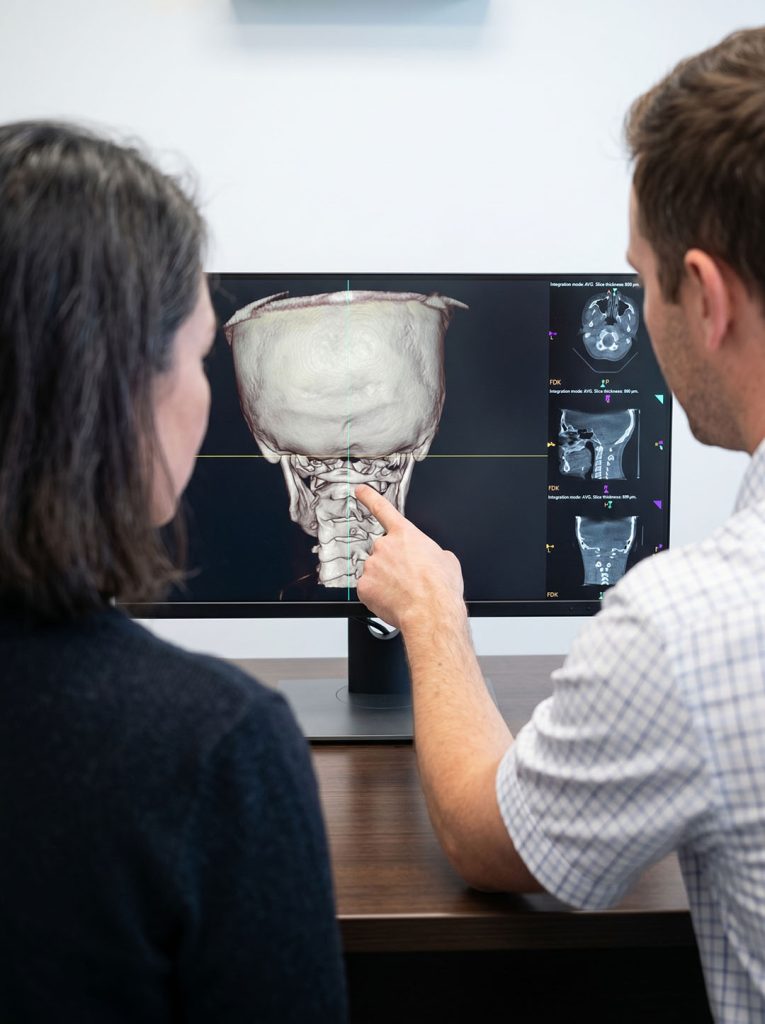
Care here starts with figuring out whether the upper cervical complex is contributing to the pain or whether something else is driving it. The exam combines hands-on assessment with NeckCare testing and imaging when appropriate. If the region is part of the picture, gentle, specific corrections are used to address it.
Headaches and migraines
Headaches and migraines come in many forms, and not all of them have a cervical component. But a meaningful number do. Cervicogenic headaches originate from the neck and refer pain into the head. Tension-type headaches often involve the suboccipital muscles at the base of the skull. And migraines, while complex, are frequently sensitive to mechanical input from the cervical spine, which is why neck position, head posture, and stiffness can trigger or worsen an episode.
The upper cervical region matters here because of its proximity to the brainstem and the dense sensory networks at the base of the skull. The suboccipital muscles are packed with proprioceptive receptors. When the joints below them are misaligned or hypomobile, those muscles stay activated, and the signals they send into the trigeminocervical system can contribute to head pain.
The first question is whether the cervical spine is part of what is driving your headaches. The exam looks at upper cervical alignment, range of motion, and muscle response patterns. If a cervical contribution is present, addressing it can change the frequency and intensity of headaches over time. Realistic expectations are important: progress is usually gradual, and headache patterns that have been around for years rarely resolve in a single visit.
Dizziness and vertigo
Dizziness has many possible causes, and several distinct conditions get grouped under the word “vertigo” even when the mechanisms are quite different. Inner ear disorders like BPPV and Meniere’s disease are common. Vestibular neuritis, an inflammation of the vestibular nerve, tends to cause an acute and severe episode that settles over weeks but can leave lasting unsteadiness behind. Mal de Debarquement Syndrome produces a persistent rocking or swaying sensation, classically after time at sea or other sustained motion. Persistent Postural-Perceptual Dizziness (PPPD) involves ongoing non-spinning dizziness that worsens with upright posture, movement, and busy visual environments, often after an initial vestibular event. Migraine-associated vertigo, vestibular hypofunction, and post-concussion dizziness account for many others. And then there is cervicogenic dizziness, which comes from altered sensory input from the neck.
Cervicogenic dizziness is often missed because the obvious place to look is the inner ear. But the upper cervical region sends some of the highest-density proprioceptive information in the body to the systems that coordinate balance. When that input becomes inaccurate, the result is often a vague unsteadiness, motion sensitivity, a feeling of floating, or dizziness that worsens with certain neck positions or with sustained postures. This overlaps considerably with how PPPD and post-concussion dizziness present, which is part of why a cervical contribution can go unrecognized for a long time. It is also common for more than one mechanism to be involved at once: an inner ear event can set off a cervical pattern, and the cervical pattern can persist long after the original problem has settled.
The exam aims to clarify what is happening. NeckCare testing for joint position sense and sensorimotor control, BTrackS balance assessment, and a careful history together help distinguish a cervical contribution from a vestibular one. In some cases the picture is mixed and care benefits from coordination with a vestibular therapist or ENT.
Post-concussion symptoms
The cervical spine is almost always involved in a concussion. The same forces that injure the brain also strain the neck, and post-concussion symptoms often persist long after the brain itself has recovered because the cervical component was never addressed.
Headaches, dizziness, brain fog, light and sound sensitivity, fatigue, and difficulty with screens and busy environments are common in the weeks and months after a concussion. Some of these are brain-related. But the upper cervical complex, the vestibular system, and the visual system are all closely linked, and disruption in one feeds the others. When the cervical spine is not assessed and treated alongside the rest of post-concussion care, recovery often stalls.
The exam looks specifically at cervical proprioception, sensorimotor control, balance, and alignment. If the region is contributing to lingering symptoms, gentle care can be part of a broader recovery plan that may also involve neurologists, vestibular therapists, or other providers already involved.
Whiplash and post-accident care
Whiplash is one of the most common reasons people end up with chronic upper cervical issues, and it does not require a dramatic accident to leave a lasting mark. Low-speed collisions, sports impacts, and even certain falls can shift the alignment of the atlas and axis enough to set up a long-term pattern. Patients often arrive years after the original event, having been told the imaging was clear and there was nothing to find.
The reason this happens is that standard imaging looks for fractures and gross instability, which most whiplash injuries do not produce. What whiplash can produce is small, specific changes in the positional relationships of the upper cervical joints. Those changes are difficult to detect on 2D x-rays but become visible with the precision of 3D CBCT imaging.
If you have post-accident symptoms that have not fully resolved, an upper cervical evaluation can clarify whether the region is contributing. The exam combines NeckCare and balance testing with imaging when appropriate. Corrections, when indicated, are gentle and specific to your anatomy.
TMJ and jaw tension
Jaw tension is rarely just a jaw problem. The temporomandibular joint, the upper cervical complex, and the muscles that connect the two work as a unit. When the cervical spine is misaligned, the jaw often compensates, and patterns of clenching, grinding, jaw clicking, or one-sided chewing can develop or worsen.
The connection runs in both directions. Posture and head position influence how the jaw tracks. The suboccipital and upper cervical muscles share neurological pathways with the muscles of mastication. And the trigeminal nerve, which supplies sensation to the face and jaw, has inputs that overlap with the upper cervical region. None of this means the cervical spine is always the source of TMJ symptoms. But it is often part of the picture.
The exam evaluates whether the upper cervical component is meaningfully contributing to the jaw pattern. If it is, addressing the region can be useful alongside whatever dental, physical therapy, or splint-based care is already in place.
Hypermobility and EDS
Hypermobile patients, including those with Ehlers-Danlos syndrome and related connective tissue conditions, often have a hard time finding care that fits. General chiropractic adjustments can be risky in this population because of ligamentous laxity, and many practitioners are reluctant to work with hypermobile patients at all.
The Blair technique is a reasonable fit for hypermobility for several reasons. The adjustment is low-force, directional, and based on imaging. There is no twisting, cracking, or rotational manipulation. And the goal is not to mobilize the joint, which hypermobile patients usually have plenty of, but to restore positional accuracy so the surrounding muscles can stop guarding.
Care for hypermobile patients tends to involve a higher proportion of supportive work, including strengthening, proprioceptive training, and slower progression. The exam looks carefully at where stability is lacking and where alignment can be improved.
POTS and dysautonomia
POTS and other forms of dysautonomia involve the autonomic nervous system, which regulates heart rate, blood pressure, digestion, and other automatic functions. The conditions are complex and rarely have a single cause, but the upper cervical region is one of the places where the anatomy makes a real difference.
The vagus nerve, the vertebral arteries, the brainstem, and the cervical sympathetic chain all pass through or near the upper cervical complex. When alignment in the region is disrupted, the signaling and circulation that depend on these structures can be affected. For patients with POTS or dysautonomia, that often shows up as worsened symptoms with certain head positions, sustained postures, or after upper neck strain.
Upper cervical care does not cure POTS or dysautonomia. What it can do, in the right patient, is address a contributing structural and neurological factor that other forms of management do not reach. The exam looks specifically at upper cervical alignment, autonomic patterns through Tytron, and balance and proprioception. Care is often most useful as one piece of a broader plan that may include cardiology, autonomic specialists, hydration and electrolyte protocols, and graded activity work.
Balance issues
Balance is a coordinated effort between three systems: the inner ear (vestibular), the eyes (visual), and the joint and muscle sensors throughout the body (proprioceptive). The upper cervical spine supplies an outsized share of the proprioceptive input. When that input is inaccurate, balance suffers, even if the inner ear and the eyes are working perfectly.
This often shows up as a vague feeling of unsteadiness, difficulty with uneven surfaces, motion sensitivity, or a sense that something is off without anything specific being wrong. Older adults are particularly affected because age-related changes to vision, vestibular function, and proprioception compound each other. Younger patients with histories of concussion, whiplash, or hypermobility see balance issues for similar reasons.
The exam uses BTrackS to objectively measure postural sway, NeckCare to assess cervical proprioception, and a careful history to understand context. Where vestibular or visual factors dominate, coordination with the right specialist is often part of the plan.
Upper back and shoulder tension
Chronic tightness across the upper back and shoulders is one of the most common complaints in the office, and it is one of the most often misinterpreted. People assume the tightness is the problem, when in many cases the tightness is the body’s response to instability or misalignment higher up the chain.
The trapezius and the muscles between the shoulder blades work hard to stabilize the head and cervical spine. When the upper cervical complex is not doing its job well, these muscles take on more than they are designed to. The result is a pattern of tension that does not respond well to stretching, foam rolling, or massage, because the underlying reason the muscles are working overtime has not changed.
The exam looks for whether the upper cervical region is driving the upper back pattern. If it is, addressing the cervical component often does more for the tension than working directly on the upper back. If it is not, soft tissue, strengthening, and ergonomic adjustments may be more useful than upper cervical care.
Meniere's disease
Meniere’s disease is a condition of the inner ear that produces episodes of vertigo, fluctuating hearing loss, tinnitus, and a sense of fullness or pressure in the ear. The cause is not fully understood, though it is thought to involve abnormal fluid pressure in the inner ear. Conventional management focuses on diet, medications, and in some cases procedures aimed at the ear itself.
The upper cervical connection is less obvious but worth understanding. The vertebral arteries, which supply blood to the brainstem and inner ear, pass through the upper cervical complex. The trigeminal and vestibular pathways converge in the brainstem near the same region. A growing body of clinical observation suggests that upper cervical misalignment can be a contributing factor in some Meniere’s presentations, particularly in patients with a history of head or neck trauma that preceded the onset of symptoms.
Upper cervical care does not cure Meniere’s disease. What it can do, in the right patient, is address a structural and neurological factor that may be contributing to the frequency or severity of episodes. The exam looks at upper cervical alignment, balance, and proprioception, and asks carefully about the history. Care is most useful as one piece of a broader plan that may include an ENT or otolaryngologist, vestibular therapy, and dietary or medical management.
Neuropathy
Peripheral neuropathy shows up as numbness, tingling, burning, or pins-and-needles sensations, most often in the hands, arms, feet, or legs. The causes are varied: diabetes, chemotherapy, autoimmune conditions, and mechanical compression somewhere along the nerve path are all common. In some cases the cause is never identified.
The upper cervical connection is worth understanding. Nerves that supply the arms and hands begin in the cervical spine, and disturbances along that pathway can contribute to neuropathic symptoms even when the primary source appears to be further downstream. This is sometimes described as a double crush pattern, where a nerve is stressed at more than one point along its length and each contribution amplifies the others. When the upper cervical complex is misaligned, the surrounding sensory pathways can be affected in ways that show up as symptoms far from the neck.
Upper cervical care is not a treatment for the systemic causes of neuropathy, and patients with diabetic or medication-related presentations should continue working with the providers managing those conditions. What upper cervical care can address is the mechanical and neurological contribution from the cervical spine, which is often overlooked and often responds well when it is a factor. The exam looks specifically at cervical alignment, nerve pathways, and how symptoms change with head and neck position.
Pruritus (chronic itching)
Chronic itching without an obvious skin cause is a frustrating condition to live with and often difficult to trace. Standard workups look at dermatological, allergic, and internal causes, and when those come back clear the patient is often left without a clear direction.
One less-recognized possibility is a neurological contribution. Itching is a sensory signal carried by specific nerve pathways, and disturbances along those pathways can produce the sensation of itch without any local skin cause. When the upper cervical region is involved, itching can appear along dermatomal patterns in the neck, shoulder, arm, or scalp. Patients often describe it as itching that does not respond to topical treatments, or that moves around, or that comes and goes with head position and posture.
The exam looks for whether the upper cervical complex is contributing to the sensory disturbance. Care is most useful in patients where dermatological and internal causes have been ruled out and the pattern of itching fits a neurological picture. When it is a fit, patients often respond well.
Carpal tunnel and hand symptoms
Carpal tunnel syndrome is usually described as compression of the median nerve at the wrist, producing numbness, tingling, weakness, or pain in the thumb, index, middle, and part of the ring finger. Conventional care focuses on the wrist itself, including bracing, ergonomic changes, injections, and in some cases surgery. Many patients get partial relief, and some do not.
The reason some cases do not resolve with wrist-focused care is that the median nerve begins in the cervical spine, and stress on the nerve higher up in the pathway can produce or worsen symptoms at the wrist. This is the double crush pattern again: two points of nerve stress along the same pathway, each amplifying the effect of the other. When the upper cervical complex is contributing, addressing the wrist alone often falls short.
The exam evaluates the whole nerve pathway, from the cervical spine through the shoulder, forearm, and wrist. If the cervical component is meaningfully involved, addressing it can change how the hand responds to whatever local care is already in place. In patients where carpal tunnel symptoms have persisted despite good conservative management at the wrist, an upper cervical evaluation is often a useful next step.